
Installing the Qbitec for Revit Plugin
Download and Installation
The installer for the latest version of the Qbitec for Revit plugin can be downloaded from the following location:
Qbitec for Revit Download Area
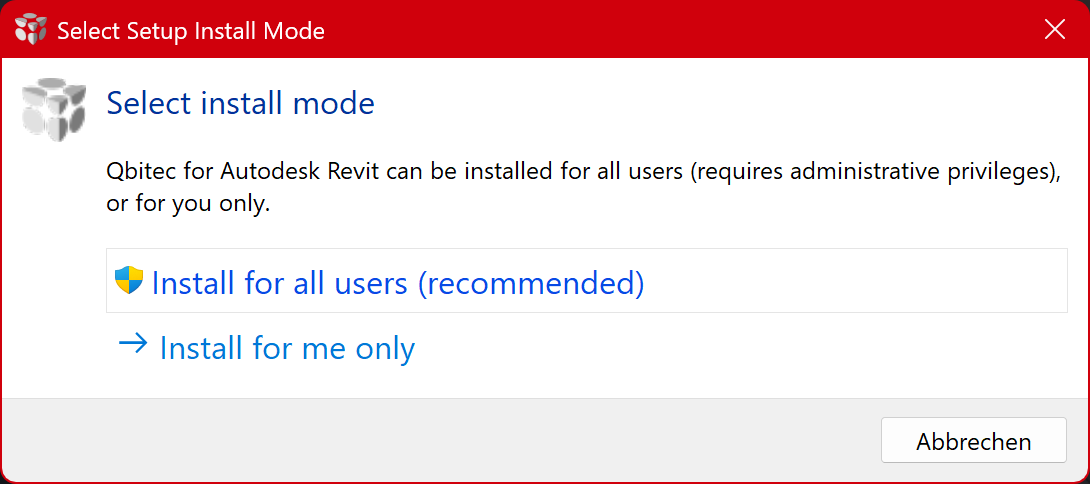
After launching the installer, select whether the plugin should be installed for the currently logged-in Windows user or for all users on the system.
Installing the plugin for all users requires administrative privileges and is the recommended deployment method.
Installation for the current user only is also supported. This option may be appropriate in scenarios such as evaluation or testing, where the software is intended for use by a single user without affecting other user accounts on the machine.
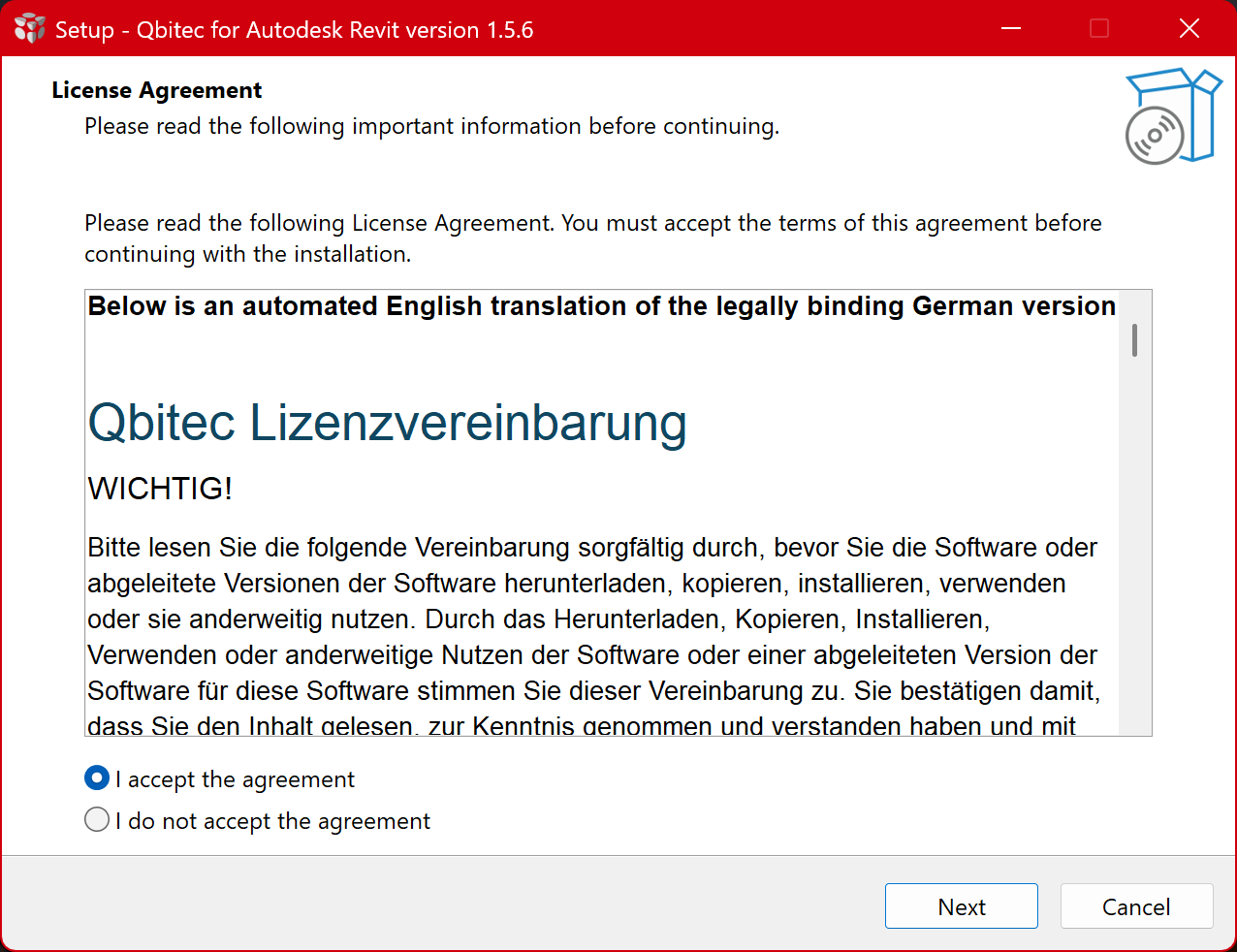
On the next page you have to accept our license agreement to proceed:
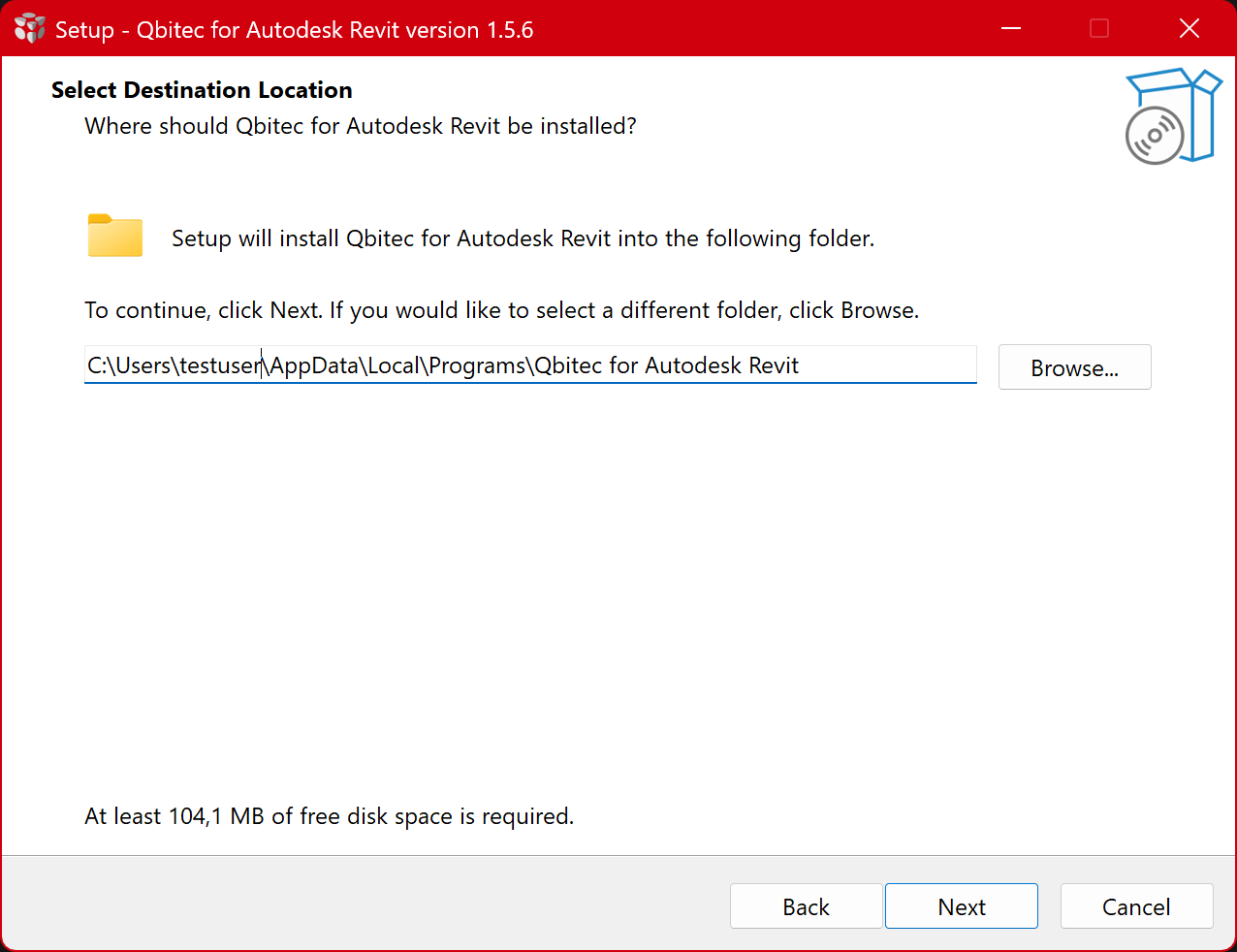
Next, you must select the installation directory for the plugin. In most cases, the automatically suggested path is appropriate and should be used.
The suggested installation path depends on the previously selected installation mode (current user or all users).
If the plugin is already installed, this step will be skipped and the plugin will be updated or reinstalled in the same directory as the existing installation.
If you do not want this behavior, please uninstall the plugin first before performing a new installation.
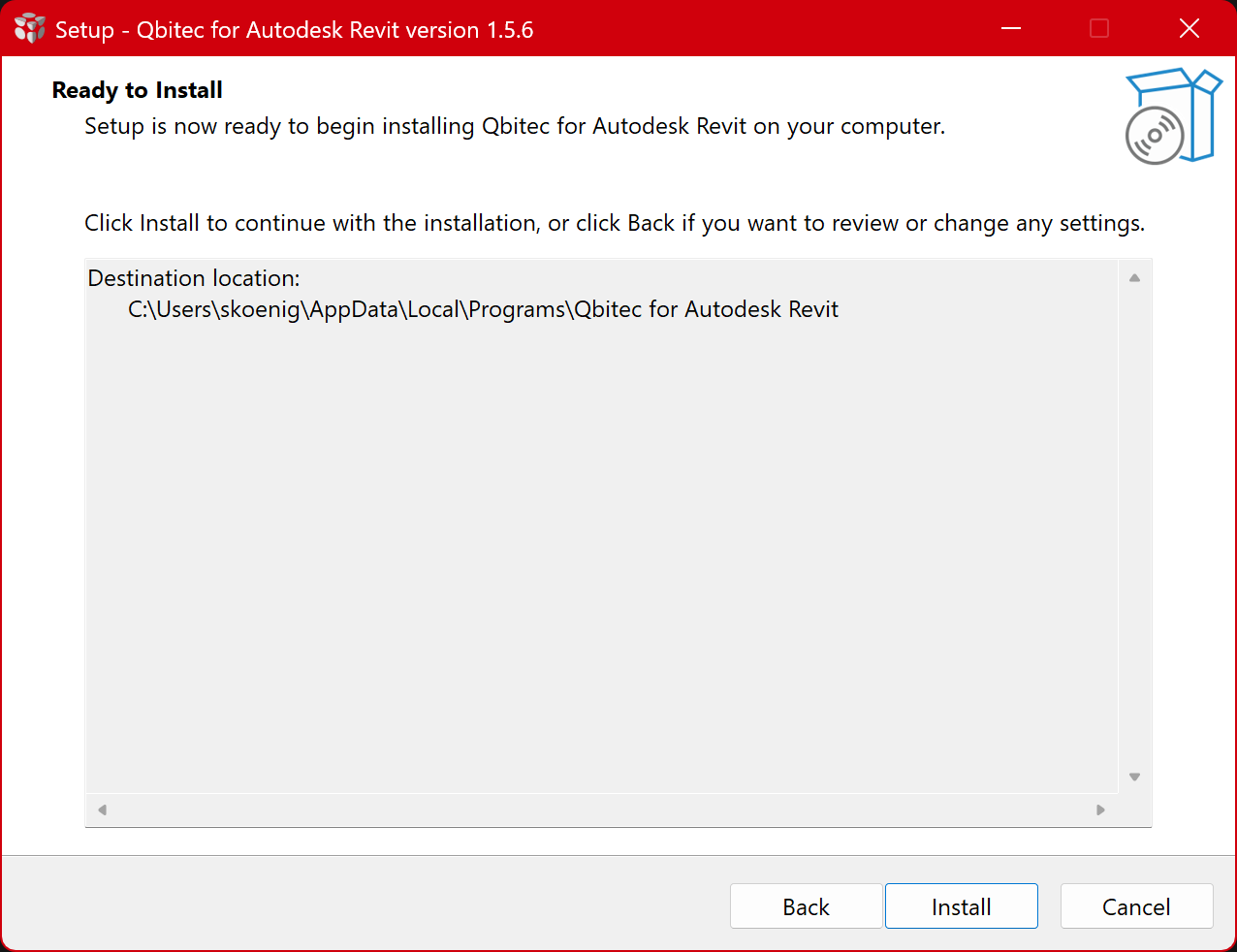
Now you have provided all information for the setup, click the install button to continue:
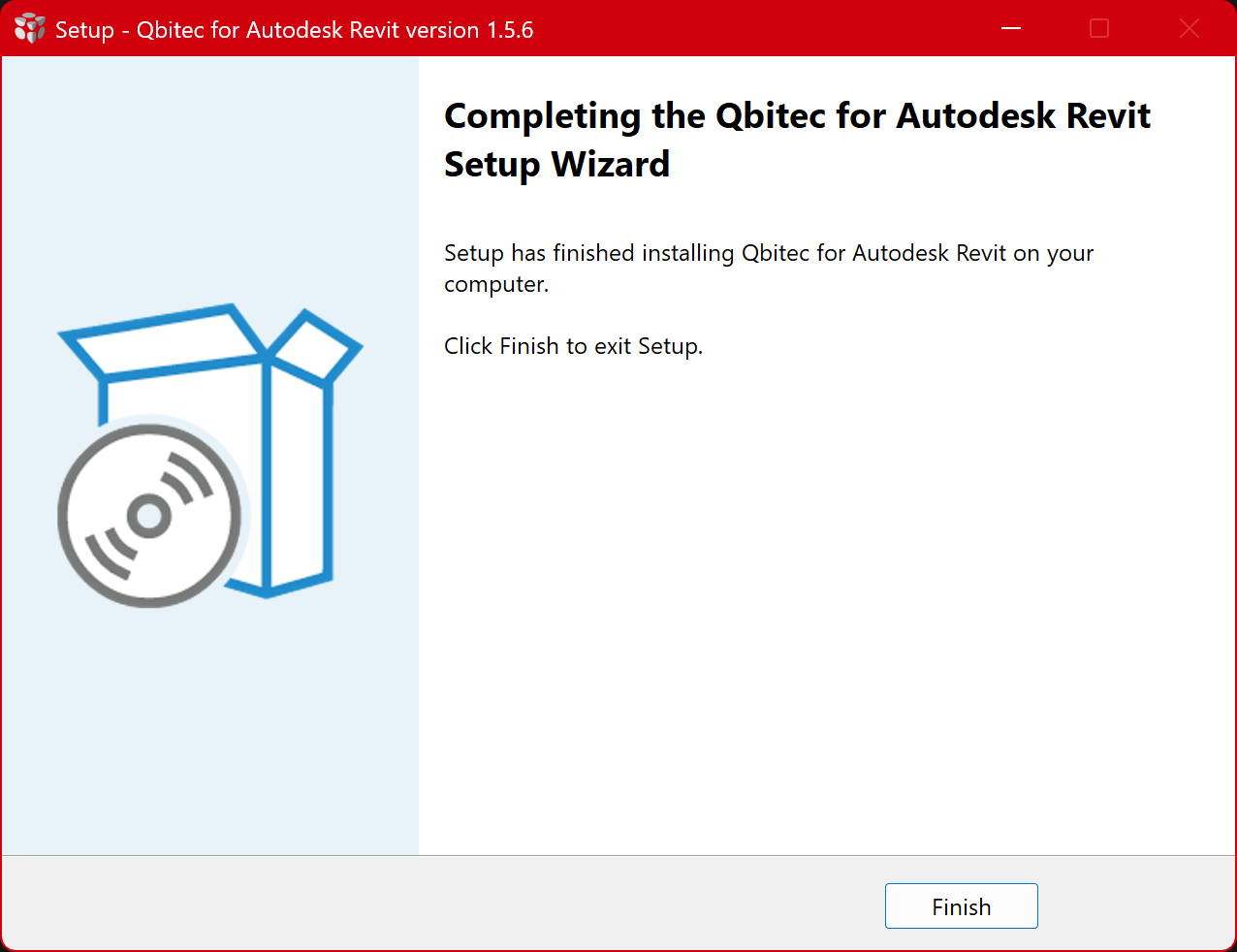
Wait for the installation to complete and click on the Finish button:
Hardware Requirements
Qbitec for Revit is aligned with the recommended system requirements of Autodesk Revit .
Qbitec for Revit should run smoothly on all mid-range systems. For converting very large point clouds, a fast, high-capacity local or USB SSD is recommended. In general, the hardware requirements are significantly lower than those required for native point cloud support.If the Qbitec for Revit Plugin is used inside a virtual machine / environment ensure that a DirectX 11 or higher compatible graphics card is available (software emulation might be too slow to work).
Advanced Topics
Installing the point cloud converter as a stand alone tool
Download the latest installer executable from here:https://qbitec.com/release/QbitecForRevit/Open a PowerShell terminal (Run as Administrator if required by your system policy).Navigate to the directory containing the downloaded installer:cd "C:\Path\To\Your\DownloadFolder"Execute the installer with the following command-line parameter(replace<version>with the actual version number of the downloaded file):.\qbitecSetup-<version>.exe /ConverterOnlyFollow the instructions of the installer wizard to complete the installation.
Firewall / Proxy Configuration
Our plugin uses the LicenseSpring service to validate licenses and to check for new versions. Please ensure that communication with the LicenseSpring RestAPI at https://api.licensespring.comis not blocked by your firewall and is correctly routed through your proxy server configuration.
In addition, if you want to connect to a NavVis source to stream point clouds and panoramic images directly into Revit, the plugin must be able to communicate with the NavVis Ivion Rest API of your Ivion instance(s). Endpoints typically have the following form:https://<instance>.iv.navvis.com/api/Some NavVis instances may also use pre-signed URLs over the AWS Cloudfront CDN using endpoints of the following form: https://<distribution-domain>.cloudfront.net/Please first verify that you can access your NavVis Ivion instance in a web browser from the same machine and using the same Windows user account. If you experience any issues accessing the web interface, contact the NavVis support team for assistance.
Proxy-Server Settings
If you are using a proxy server, the plugin attempts to automatically detect the proxy settings from your Windows configuration. If this does not work correctly, you can manually specify the proxy server to use by setting the following registry key of type REG_SZ:
HKEY_CURRENT_USER\Software\Qbitec\QbitecForRevit\Settings\ProxyUri

It is also possible to switch between the different behaviors on how to resolve the correct proxy with the registry key of type REG_DWORD:
HKEY_CURRENT_USER\Software\Qbitec\QbitecForRevit\Settings\ProxySetting
Possible values are:
Silent Installation (without GUI)
In some environments, administrators need to install software via scripts without any graphical user interface (GUI), for example when deploying the application automatically to multiple PCs.
The installer supports silent installation using the /VERYSILENT command-line option.
Silent installation for all users (requires elevated privileges)
Download the latest installer executable from here:https://qbitec.com/release/QbitecForRevit/Open a PowerShell terminal withAdministrator privileges.Navigate to the directory containing the installer.cd "C:\Path\To\Your\DownloadFolder"Execute the following command(replace<version>with the actual version number of the downloaded file):.\qbitecSetup-<version>.exe /ALLUSERS /VERYSILENT
This installs the plugin for all users on the system without showing any installer dialogs.
Silent installation for the current user only
Download the latest installer executable from here:https://qbitec.com/release/QbitecForRevit/Open a normal (non-elevated) PowerShell terminal.Navigate to the directory containing the installer.cd "C:\Path\To\Your\DownloadFolder"Execute the following command(replace<version>with the actual version number of the downloaded file):.\qbitecSetup-<version>.exe /CURRENTUSER /VERYSILENT
This installs the plugin only for the currently logged-in user without any GUI interaction.